GY4027
Topic 2: Erosion and Transport
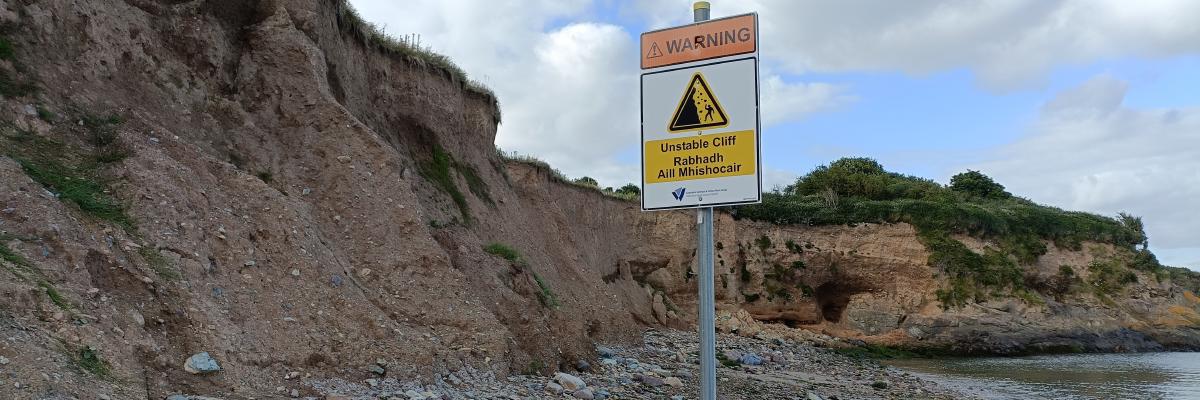
The landscape is shaped by moving material around. This topic, we consider the four agents of erosion and transport: gravity, water, ice, and air.
By the end of this topic you should be able to:
- List the four principal transport agents
- Describe how gravity erodes and transports materials
- Describe how water erodes and transports materials
- Describe how ice erodes and transports materials
- Describe how air erodes and transports materials
Lecture
Lecture slides: L2 Erosion and Transport
Reading
Suggested Textbook
I suggest reading Chapter Three of Huggett, R. (2017) Fundamentals of Geomorphology, 4th Edition. Routledge, London.
Chapter Three is the chapter on reconstructing the geomorphological history of an area. This is a different topic to that covered in the lecture, but I think it will help you to understand the papers assigned as additional reading.
Available online.
Academic papers
- Baker, M.M., Newman, C.E., Lapotre, M.G.A., Sullivan, R., Bridges, N.T., and Lewis, K.W. 2018. Coarse sediment transport in the modern Martian environment. Journal of Geophysical Research: Planets 123, 1380–1394. doi: 10.1002/2017JE005513
There’s little that will help to understand processes we take for granted more than changing some of the fundamentals of those processes. So, I suggest reading this paper on aeolian sediment transport on Mars. Different atmospheric pressure, different gravity. Some of it is a bit complex, but I think it will really help you to understand the processes of aeolian sediment transport on Earth.
- Burr, D.M., Emery, J.P., Lorenz, R.D., Collins, G.C., and Carling, P.A. 2006. Sediment transport by liquid surficial flow: application to Titan. Icarus 181, 235–242. doi: 10.1016/j.icarus.2005.11.012
Same idea as above. There’s only two bodies in the solar system with liquid on the surface: Earth, and Saturn’s moon Titan. Let’s see how liquid sediment transport works on Titan. By the way, note I said ‘liquid’ there. It’s not water.
PS - IGNORE THE MATHS. Unless you’re really into it. Just assume they’re right about all the equations. But do try to understand what they’re concluding from the maths.
- Howard, A.D., Moore, J.M., Umurhan, O.M., White, O.L., Anderson, R.S., McKinnon, W.B., Spencer, J.R., Schenk, P.M., Beyer, R.A., Stern, S.A., Ennico, K., Olkin, C.B., Weaver, H.A., and Young, L.A. 2017. Present and past glaciation on Pluto. Icarus 287, 287–300. doi: 10.1016/j.icarus.2016.07.006
You’re getting the idea by now, right? Let’s have a look at glaciers on Pluto. And yeah, it’s not water ice.
- Krohn, K., Jaumann, R., Otto, K., Hoogenboom, T., Wagner, R., Buczkowski, D.L., Garry, B., Williams, D.A., Yingst, R.A., Scully, J., De Sanctis, M.C., Kneissl, T., Schmedemann, N., Kersten, E., Stephan, K., Matz, K.-D., Pieters, C.M., Preusker, F., Roatsch, T., Schenk, P., Russell, C.T., and Raymond, C.A. 2014. Mass Movement on Vesta at Steep Scarps and Crater Rims. Icarus 244, 120–132. doi: 10.1016/j.icarus.2014.03.013
How about gravity as a transport process in a place with very low gravity? The asteroid Vesta.